Women · 28% body fat · ACE: Average
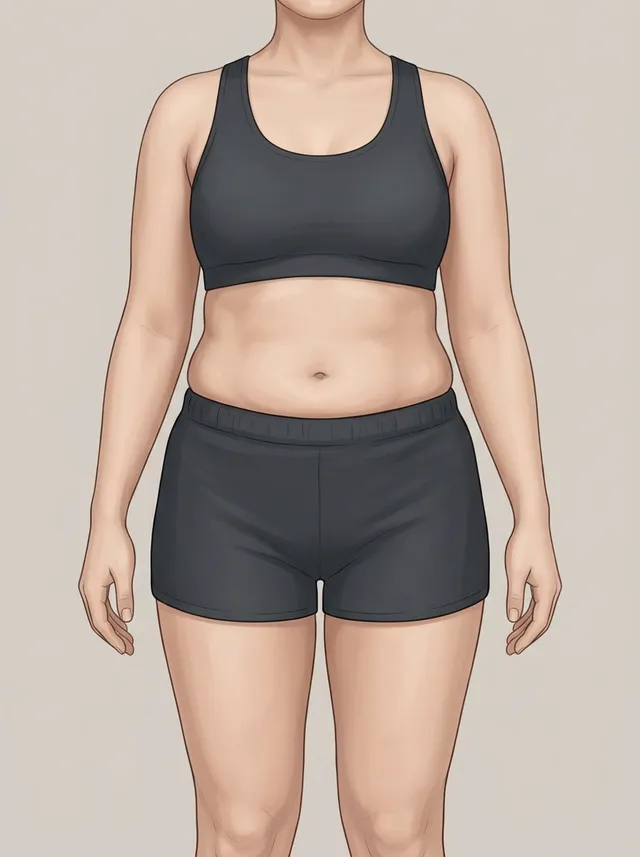
What does 28% body fat look like on a woman?
A softly rounded stomach and fuller waist, hips and thighs.
What you would see
- The stomach is softly rounded and the waist is fuller.
- The hips and thighs are noticeably fuller.
- The upper arms are fuller, with no visible muscle definition at rest.
- Shape still comes from the hips; the waist is less sharply defined than at lower percentages.
Your photo stays private.We analyze it once, then throw it away. Never saved, never shared, no account needed.
Who is usually at 28%
Right in the middle of what ACE calls "average" for women, and extremely common. A first-cut target of 25% is a modest step.
What 28% means for health
28% is mid-range in ACE's "average" band for women (25-31%). It is a normal range, though waist size and cardiovascular fitness matter at least as much as the body fat number.
| Essential fat | 10-13% | |
|---|---|---|
| Athletes | 14-20% | |
| Fitness | 21-24% | |
| Average | 25-31% | 28% is here |
| Obese | 32%+ |
How long from 28% to 25%?
Example: a 150 lb woman at 28% body fat carries about 108 lb of lean mass. If that stays constant, 25% body fat is about 144 lb, so roughly 6 lb of fat to lose.
~8 wks
at 0.5% of body weight per week
~4 wks
at 1% of body weight per week
The 0.5-1% weekly range is what Helms et al. (2014) recommend to maximise muscle retention, and Garthe et al. (2011) found athletes losing 0.7% per week gained lean mass while those losing 1.4% did not. Treat these as best-case timelines: water, adherence, and the fact that the last few points go slower all add time. Your body weight changes the pounds, not the percentages.
What to do next
Sensible first steps: resistance training twice or three times a week, 8k-ish steps and enough protein. A modest deficit from your TDEE takes you toward 25%.
Think you are around 28%? Check with a photo.
Upload a front-facing photo and get an AI estimate range in seconds. Free, no signup. Prefer to compare by eye? Use the full chart.
Upload a photo → AI estimate (free)Your photo stays private.We analyze it once, then throw it away. Never saved, never shared, no account needed.
Compare with the next steps
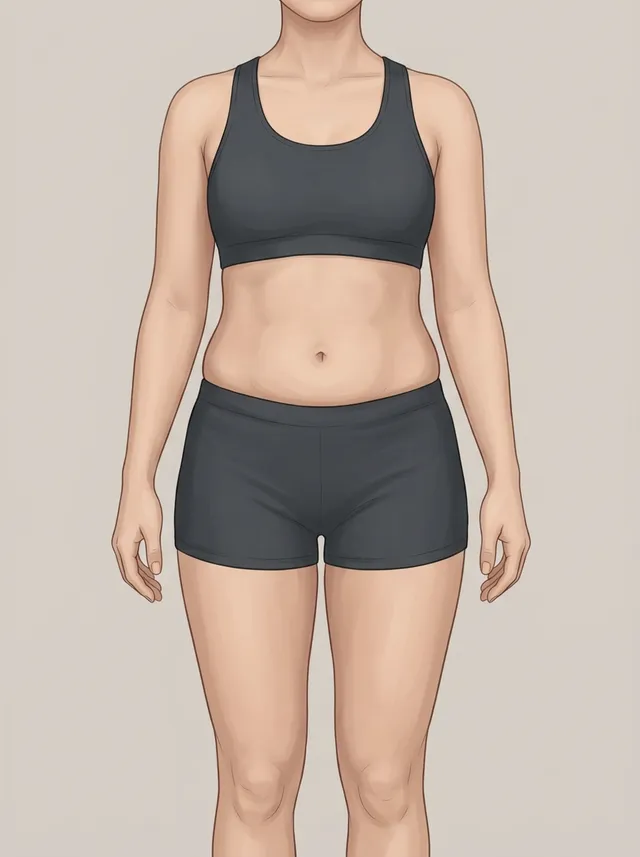
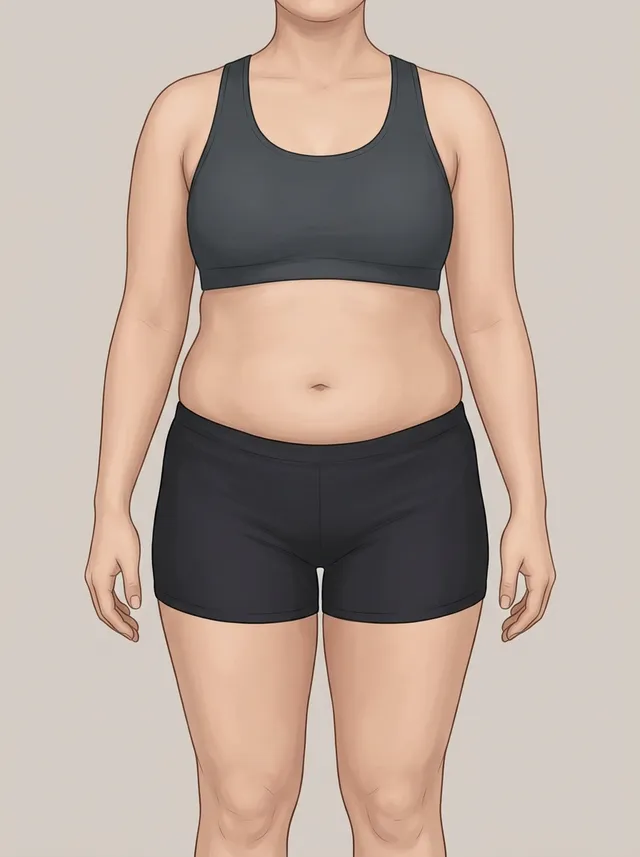
AI-generated illustration, approximate; real bodies vary.
Frequently asked questions
How long does it take to get from 28% to 22% body fat?
For a 150 lb woman at 0.5-1% of body weight per week, about 8 to 15 weeks (roughly 11 lb of fat), assuming you keep your muscle. See the worked numbers above.
Is 28% body fat overweight for a woman?
It is inside ACE's "average" band (25-31%). "Overweight" is usually defined by BMI. Gallagher et al. (2000) show how BMI cut-offs map to body fat ranges but with real error, so a single number does not tell the whole story.
Why do two women at 28% body fat look different?
Body fat percentage is an average across the whole body. Where fat is stored (belly, hips, thighs, arms), how much muscle you carry, height, posture, lighting and even the time of day all change how the same percentage looks. The illustration on this page is one approximate example, not a standard. Real bodies vary.
How can I check whether I am really at 28%?
Compare yourself with the illustrations as a first pass, then use a second method: the free AI photo estimate on baisics, the US Navy tape-measure method, skinfold calipers, or a DEXA scan. Every method has error. Gallagher et al. (2000) report prediction errors of roughly 3-5 percentage points even for models built on lab-grade measurements, so treat any single number as a range and track the trend over weeks.
Keep going
- TDEE calculator →Find your maintenance calories, then subtract for a deficit. Add your 28% for a lean-mass based number.
- Macro calculator →Turn your calories into protein, carb and fat grams.
- Training templates →Beginner-friendly strength programs to start with.
- High-protein recipes →Recipes with macros on every card, easy to fit to your calorie target.
- What 25% looks like →The next step leaner for women.
- What 30% looks like →The next step up for women.
Sources
- American Council on Exercise (ACE). "What Are the Guidelines for Percentage of Body Fat Loss?" Body fat categories: essential fat, athletes, fitness, average, obese. Descriptive fitness categories, not a diagnosis. https://www.acefitness.org/resources/everyone/blog/112/what-are-the-guidelines-for-percentage-of-body-fat-loss/
- Gallagher D, Heymsfield SB, Heo M, Jebb SA, Murgatroyd PR, Sakamoto Y. "Healthy percentage body fat ranges: an approach for developing guidelines based on body mass index." Am J Clin Nutr. 2000;72(3):694-701. https://doi.org/10.1093/ajcn/72.3.694
- Helms ER, Aragon AA, Fitschen PJ. "Evidence-based recommendations for natural bodybuilding contest preparation: nutrition and supplementation." J Int Soc Sports Nutr. 2014;11:20. https://doi.org/10.1186/1550-2783-11-20
- Garthe I, Raastad T, Refsnes PE, Koivisto A, Sundgot-Borgen J. "Effect of two different weight-loss rates on body composition and strength and power-related performance in elite athletes." Int J Sport Nutr Exerc Metab. 2011;21(2):97-104. https://doi.org/10.1123/ijsnem.21.2.97
General information, not medical advice. Body fat categories are descriptive fitness bands, not diagnoses.