Men · 8% body fat · ACE: Athletes
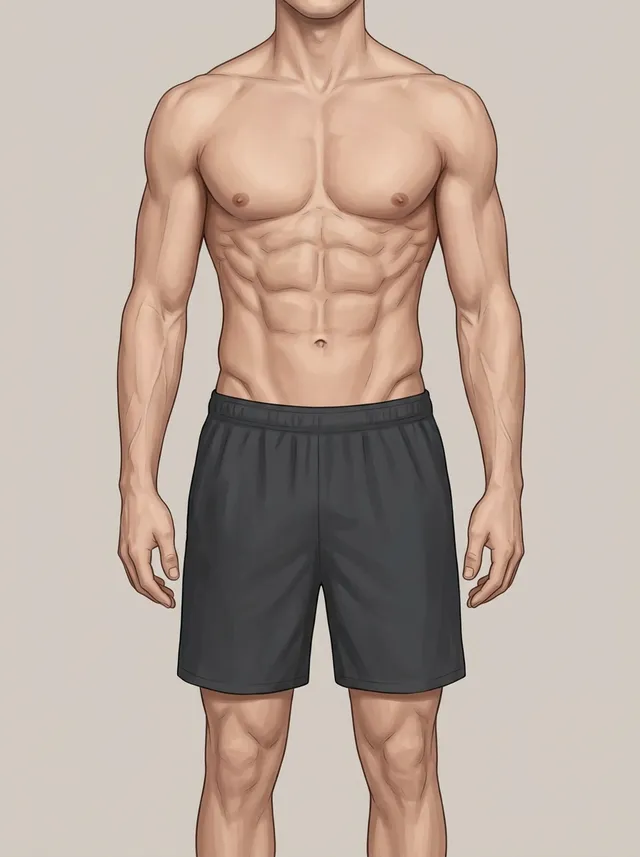
What does 8% body fat look like on a man?
Shredded: every ab separated, veins on the forearms, nothing soft at the waist.
What you would see
- All eight abs are separated by deep lines, and the serratus ribs show on the sides.
- Chest and shoulder muscles show clear separation; the delts look striated in good light.
- Veins are visible on the forearms and lower abs, and the lower back shows definition.
- No pinchable fat at the waist, and the face and neck look noticeably leaner.
Your photo stays private.We analyze it once, then throw it away. Never saved, never shared, no account needed.
Who is usually at 8%
This is stage-lean or very-lean-athlete territory. Most men who reach 8% do it deliberately, for a season or an event, rather than living there year round.
What 8% means for health
ACE puts men at 6-13% in its "athletes" band, and 8% sits in the lower half of it, close to the 2-5% essential-fat band. Staying very lean for long periods can mean chronically low energy intake. The IOC consensus statement on relative energy deficiency in sport (RED-S) describes the performance and health risks of sustained low energy availability, so this is a level most people do not hold year round.
| Essential fat | 2-5% | |
|---|---|---|
| Athletes | 6-13% | 8% is here |
| Fitness | 14-17% | |
| Average | 18-24% | |
| Obese | 25%+ |
Staying around 8%
8% is the leanest level in this guide, so there is no leaner step to plan for. If you are here on purpose, the work now is maintenance: eat enough to train well, sleep, and keep strength training so the leanness is muscle you kept. If it feels hard to hold, that is information, not failure.
What to do next
If you are here on purpose, plan the exit: bring calories back up gradually rather than rebounding. If you are here by accident (heavy training, little eating), eat more before chasing leaner. For a lean-bulk calorie target, start from your TDEE.
Think you are around 8%? Check with a photo.
Upload a front-facing photo and get an AI estimate range in seconds. Free, no signup. Prefer to compare by eye? Use the full chart.
Upload a photo → AI estimate (free)Your photo stays private.We analyze it once, then throw it away. Never saved, never shared, no account needed.
Frequently asked questions
Is 8% body fat healthy for a man?
It falls inside ACE's "athletes" range of 6-13% for men, but it is near the lean limit. It is typically a short-term, deliberate state. The IOC RED-S consensus statement describes risks from sustained low energy availability, so if you feel run down, cold, or your training is suffering, it is worth eating more or speaking to a clinician.
Can I see my abs at 8% without flexing?
Yes, for most men. At 8% all abs are normally visible relaxed in good lighting. Fat distribution varies, though: some men show lower abs at 12%, others still hold a little lower-belly fat at 8%.
Why do two men at 8% body fat look different?
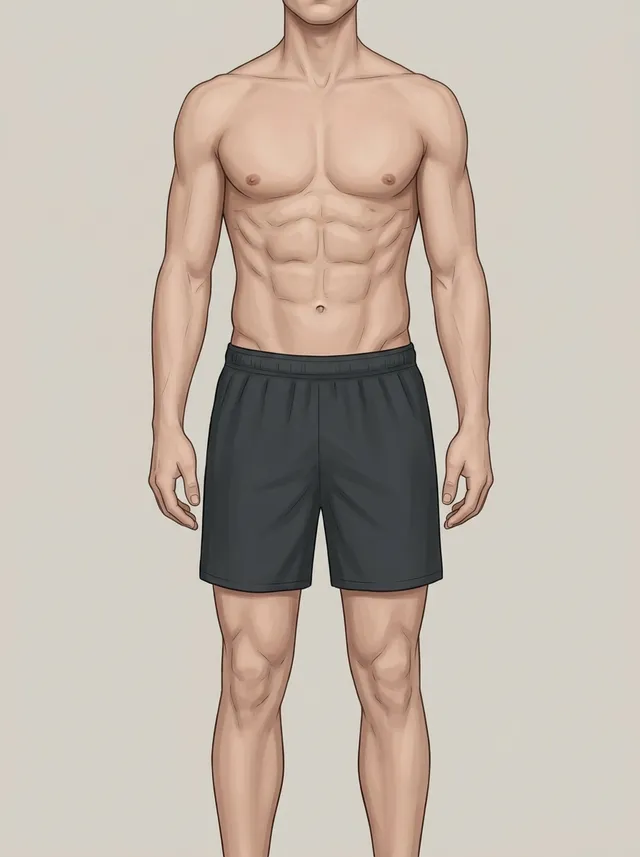
Body fat percentage is an average across the whole body. Where fat is stored (belly, hips, thighs, arms), how much muscle you carry, height, posture, lighting and even the time of day all change how the same percentage looks. The illustration on this page is one approximate example, not a standard. Real bodies vary.
How can I check whether I am really at 8%?
Compare yourself with the illustrations as a first pass, then use a second method: the free AI photo estimate on baisics, the US Navy tape-measure method, skinfold calipers, or a DEXA scan. Every method has error. Gallagher et al. (2000) report prediction errors of roughly 3-5 percentage points even for models built on lab-grade measurements, so treat any single number as a range and track the trend over weeks.
Keep going
- TDEE calculator →Set maintenance or lean-bulk calories. Add your 8% to use Katch-McArdle.
- Macro calculator →Turn your calories into protein, carb and fat grams.
- Training templates →Free strength programs to keep the muscle you have built.
- High-protein recipes →Recipes with macros on every card, easy to fit to your calorie target.
- What 10% looks like →The next step up for men.
Sources
- American Council on Exercise (ACE). "What Are the Guidelines for Percentage of Body Fat Loss?" Body fat categories: essential fat, athletes, fitness, average, obese. Descriptive fitness categories, not a diagnosis. https://www.acefitness.org/resources/everyone/blog/112/what-are-the-guidelines-for-percentage-of-body-fat-loss/
- Mountjoy M, Sundgot-Borgen JK, Burke LM, et al. "IOC consensus statement on relative energy deficiency in sport (RED-S): 2018 update." Br J Sports Med. 2018;52(11):687-697. https://doi.org/10.1136/bjsports-2018-099193
- Gallagher D, Heymsfield SB, Heo M, Jebb SA, Murgatroyd PR, Sakamoto Y. "Healthy percentage body fat ranges: an approach for developing guidelines based on body mass index." Am J Clin Nutr. 2000;72(3):694-701. https://doi.org/10.1093/ajcn/72.3.694
General information, not medical advice. Body fat categories are descriptive fitness bands, not diagnoses.